OnBaSys project: Online-EIS battery system for stationary energy storage
.png)
Motivation
Sodium-ion (Na-ion) batteries have gone through remarkable development in recent years. Unlike many other promising next-gen battery technologies, Na-ion batteries have achieved the necessary level of maturity to support large-scale market adoption. Large companies are already signing contracts in the multi-GWh range (here). The central question, however, remains: can Na-ion batteries compete with lithium-ion (Li-ion) technologies in real-world stationary storage applications?
The key advantage of Na-ion batteries is their sustainability and the use of widely available, low-cost raw materials. With the right choice of cathode material, Na-ion cells can avoid many controversial or supply-constrained materials such as lithium, cobalt, and nickel. In fact, Na-ion cells can even use aluminum instead of copper for the anode current collector, reducing their cost and reliance on constrained resources even further.
As a result, Na-ion technology has the potential to deliver not only lower cell costs, but also a more secure and resilient supply chain with less exposure to geopolitical disruption.
All these advantages come with trade-offs, however. The most notable disadvantage of Na-ion batteries is their energy density, which is typically ~20–40% lower than LFP-based Li-ion batteries. Battery lifetime is another uncertainty: commercial operating data is still limited, and long-term field performance has not yet been proven at scale. Ultimately, Na-ion batteries will only be viable for broad deployment if they demonstrate sufficient lifetime and safe operation under real operating conditions.
Taking both strengths and limitations into account, Na-ion batteries are a strong candidate for battery energy storage systems (BESS). In stationary applications, total cost of ownership (TCO) is often more important than energy density. This means Na-ion adoption will largely depend on achieving long service life using low-cost, sustainable materials, and having the monitoring and analytics in place to ensure performance and safety over time.
Project goals
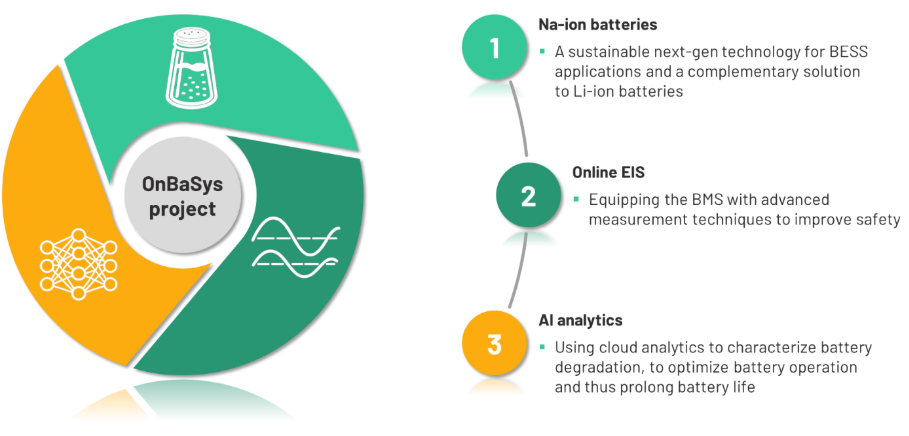
The OnBaSys project aims to advance Na-ion batteries beyond cell development alone. Its goal is also to enable better performance and stronger lifetime outcomes through modern monitoring and diagnostic capabilities. Concretely, the OnBaSys project combines three innovative battery technologies to achieve this:
- Na-ion batteries
- Online electrochemical impedance spectroscopy (EIS)
- AI-based battery analytics
Na-ion batteries
Within the scope of this project, we evaluate the market potential of Na-ion batteries specifically for BESS applications. A BESS can operate across a wide range of use cases, each with different performance requirements and load profiles. Identifying the right market fit can make all the difference in a system’s long-term commercial success.
Besides investigating market potential, the aim of this project is also to support the development and manufacturing of Na-ion cells designed to serve the markets that are concluded to be the best match for these cells.
Online EIS
Electrochemical impedance spectroscopy (EIS) is an established laboratory technique used to measure battery impedance with high accuracy. It has proven valuable for gaining deeper insight into degradation mechanisms and assessing the safety state of batteries.
The goal of involving online EIS in the OnBaSys project is to bring this capability out of the lab and into the battery system during operation. By measuring impedance in-operando, online EIS enhances the BMS by providing an entirely new set of input signals. This enables more advanced monitoring approaches and supports earlier detection of abnormal behavior.
For safety-related diagnostics such as the early detection of conditions that may lead to thermal runaway, Online EIS represents a significant step forward.
AI-based analytics
Cloud-based battery analytics have already demonstrated major benefits in Li-ion BESS deployments and are increasingly becoming a standard layer of modern energy storage operations. These systems analyze large volumes of operational data across entire fleets, enabling insights that cannot be derived from local system data alone.
Cloud-based battery analytics can support, among other outcomes:
- Improved safety monitoring beyond the BMS layer
- More accurate state-of-charge (SOC) estimation to support trading and dispatch
- Warranty and performance tracking
- Predictive maintenance triggers
- Extended lifetime through data-driven operating strategies
These outcomes rely on fundamental state estimations such as state-of-charge (SOC) and state-of-health (SOH). Within the scope of the OnBaSys project, these analytics are developed specifically for Na-ion batteries. A key focus is to address the degradation of Na-ion batteries: by combining model-based and AI-based methods informed by real operational data, the OnBaSys project aims to better characterize Na-ion degradation behavior and enable strategies that prolong battery life in BESS applications.
Summary
Na-ion batteries offer a promising, sustainable, and cost-effective alternative for large-scale stationary energy storage applications. However, widespread adoption will depend on demonstrating long lifetime and safe performance under real operating conditions.
The OnBaSys project addresses this challenge by combining Na-ion battery technology with in-operando impedance monitoring (Online EIS) and AI-driven analytics. By enabling in-operando diagnostics and data-driven lifetime optimization, OnBaSys aims to unlock the full potential of Na-ion batteries for BESS applications, improving safety, reliability, and total cost of ownership.
The OnBaSys project is funded by the European Union (Funding code: EFRE-20801473)